 Mini-Converters
 Digital Recorders
 Mobile I/O
 Desktop I/O
 Color
Color
 Streaming
 IP Video/Audio
 Frame Sync
 openGear
 Routers
 Recording Media
 Developer
 Software










Kean Production Services on Delivering Consistent Color Across Event Displays
September 24, 2026
Share
 Email
Email
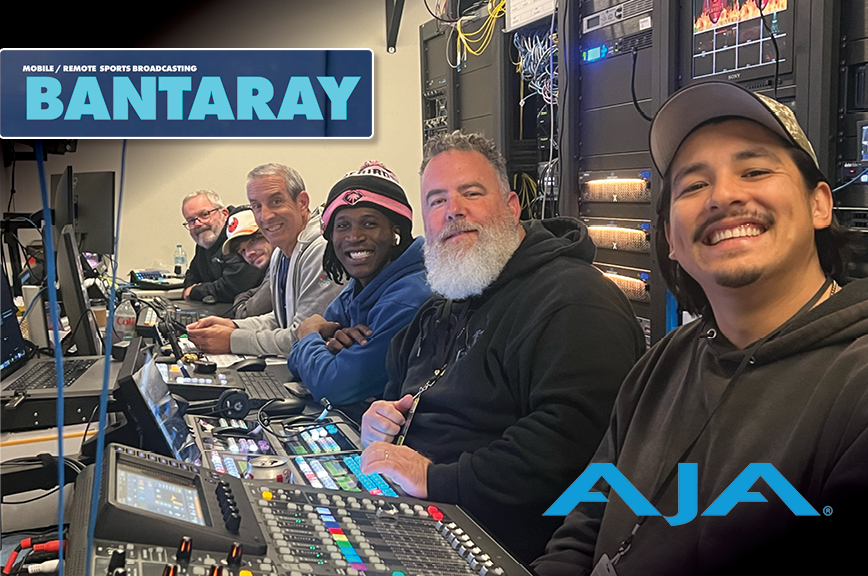
Corporate event audiences are quick to spot when an image looks “off” on an in-venue display. It’s a distraction that can undercut even the most impressive event programming. Yet, achieving consistent color across every in-room display, from LEDs to projection screens, remains a hurdle for many corporate event production teams. In our latest sit-down with Chris Kean of Kean Production Services, we explore why and how he and colorist Angel Banchs built a pipeline with AJA ColorBox to solve the challenge.
To kick things off, tell us more about what you do.
My wife and I own Kean Production Services. We’re a boutique shop that specializes in building wide, high-resolution LED systems that deliver the horsepower and capacity that large-scale corporate event productions require. We’ve been around for 15 years, handling niche display challenges for clients, but we also work with broadcasters, operate graphics systems, and provide equipment and stage management. Our team handles pre-production engineering support, design templates, pre-production documents, and on-site operators.
How’d you get started in the business?
After spending some time in motion effects animation, I realized I was more cut out for fixing systems and became a junior engineer in charge (EIC) for broadcast trucks. Then I was an EIC for a broadcaster and an integrator, where I was introduced to AJA. Their gear quickly became my go-to; the reputation, the warranty, and the support were all above and beyond anything else I’d experienced. Even in the most critical situations, AJA gear has always taken care of me, so whenever given the opportunity, I opt for AJA products over other brands.
What’s driving demand for your unique expertise?
Post pandemic, people came to appreciate being in the same physical space, but the more people you pack into a room, the larger the size of the LEDs you need. Widescreen LED technology is maturing fast, but achieving color consistency across displays remains a struggle. In a perfect world, the colors on the display match the brand’s identity and look the same across LED walls and projection screens. This is where our team comes in. Color is complicated and requires specialized knowledge of 3D lookup tables (LUTs) and calibration that our clients who produce these shows don’t have time to learn, so we provide that service for them.
When did color matching become a priority for your clients?
It's a more recent development in live corporate events, but demand for this kind of work will only continue to grow. Projection and LED colors never match, because both technologies emit light differently. Getting them to look similar is time-consuming and often requires the expertise of a projectionist, LED engineer, screen switcher engineer, and colorist. Most today will do an A/B comparison test and move the slider down a bit to tweak the color until it looks the best it can.
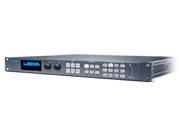
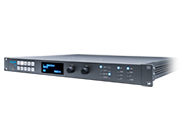
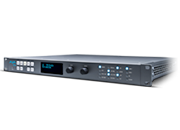
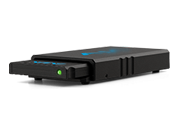
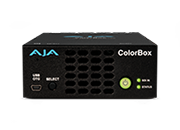
AJA ColorBox is changing that. It gives us the right calibration tools to get clients closer to a more color-accurate look across displays. Sure, you can eyeball it with a correction or 3D LUT, but we see ColorBox providing an opportunity to take the production quality up a notch. It replaces guesswork with decision-making that’s rooted in math and science. We want the audience to leave happy with their experience and excited to return. High-end color management with a tool like ColorBox makes that easier to achieve.
Describe the workflow in the context of an event production.
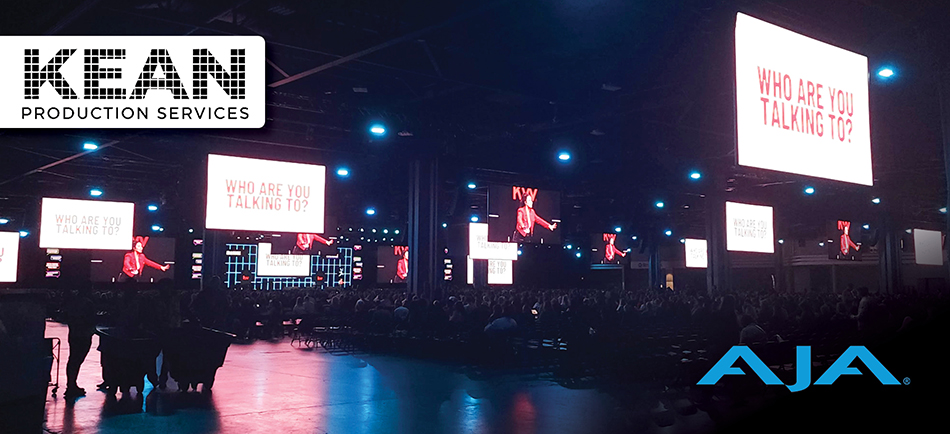
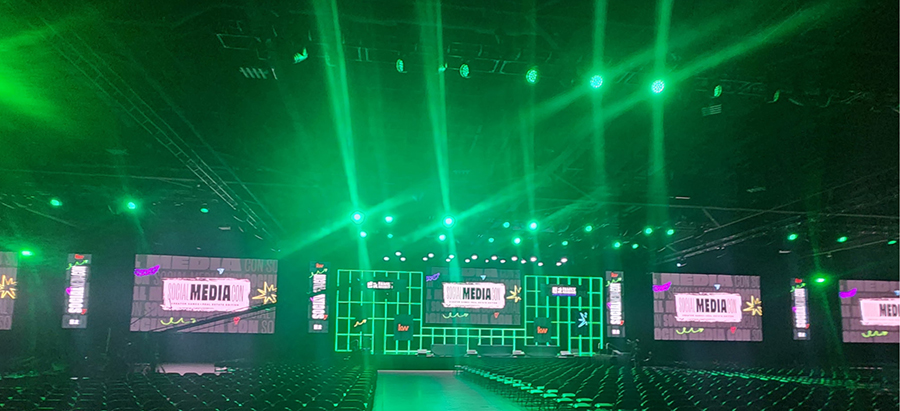
The Keller Williams Family Reunion, which we worked on earlier this year, is a great example. It was a three-day event that took place at the Georgia World Congress Center in Atlanta, where real estate professionals gathered to learn and network. The event included a keynote stage with a main LED wall and 24 projectors across main and delay positions. We were a team of 18 and had three days to get everything set up and rehearsal-ready, so the pressure was tremendous.
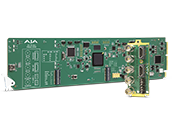
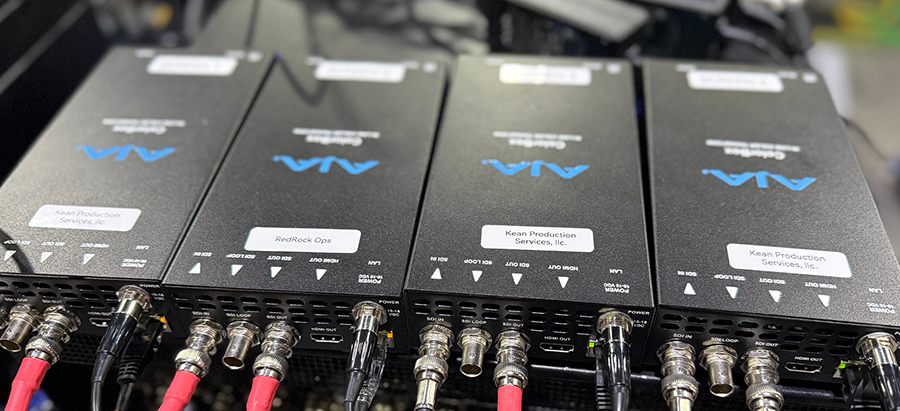
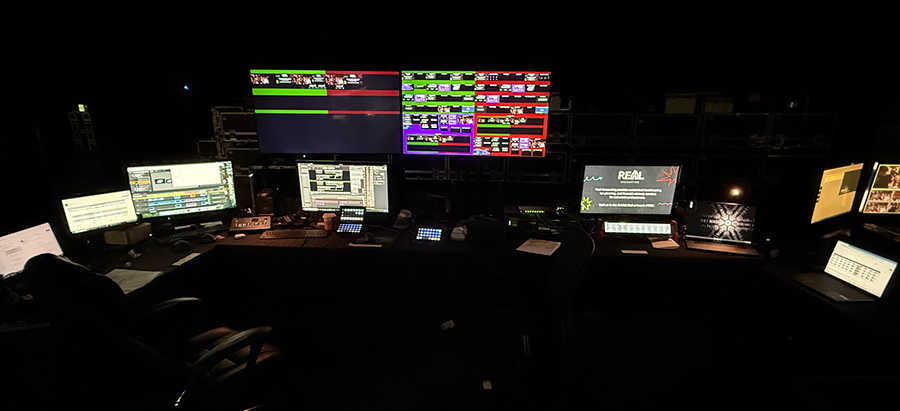
The screen switcher I used for the project, a Spyder X80, was designed at a time when advanced color control wasn’t available in the way it is today, so when the client told me they wanted to focus on improving the color, we brought in Angel Banchs from Red Rock Ops LLC as the colorist. He spec’d out ColorBoxes, which we carry in our inventory, so it was easy for us to integrate them into the signal flow alongside Pomfort Livegrade and Portrait Displays Calman.
Angel had the LED profiled before we ever got to site, then profiled both the LED and the projectors on the floor and targeted everything to Rec. 709. That target was driven by the content creation team. The LED and projection teams sat right next to each other, so we needed a standard both technologies could accurately hit. Angel measured with a Klein K-10A and a Colorimetry Research CR-250 spectroradiometer, using the CR-250 to profile the K-10A for each display type, and drove patterns from a networked Portrait Displays G1 generator running off a mobile DIT cart with the meters on top. This allowed him to move anywhere on the floor.
Everything came into my Spyder X80, and my outputs went to the 24 projectors and the LED wall. LED correction lived in Brompton SX40 processors, with the four ColorBoxes on the projection path: one on the two main house left projectors, one on the two main house right projectors, and one on each of the ten-projector delay chains – house left and house right.
Calman read the measurements and generated the correction LUTs, which Angel loaded into Livegrade and pushed to the ColorBoxes on the projection path. Since the projector LUT engines are limited next to what ColorBox can do, we deliberately kept projector-side processing to a minimum. The projectionists set center white on each unit, and the ColorBoxes carried the match across the different projector types.
ColorBox latency is small enough that putting it in line was never a concern for IMAG. Once we were calibrated, we were reading under 2 dE2000 between the main projectors and the LED wall, and around 3 dE2000 on the delays, which were different units sitting in a different part of the room. That is a real result across three display technologies that we pushed to the ColorBoxes and LED processors to achieve the right color.
This workflow was key because a lot of the content for the displays was red, which is difficult to color-match. Projection primaries simply cannot reach LED red, so the fix isn't tweaking; it's defining a common target both technologies can hit and mapping them to it. Before using the ColorBox, it looked completely jarring.
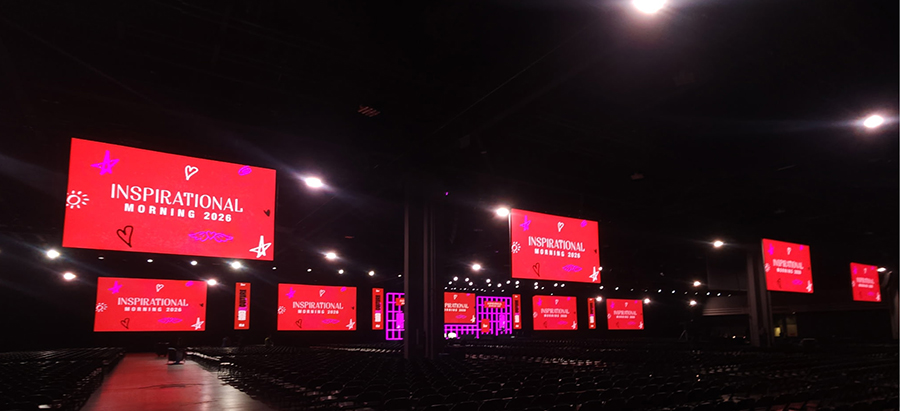
Once we put those in line and Angel began his work, we were able to send a calibrated signal and use internal patterns to match the projection screens, which was neat to see. The part the projectionists reacted to most was the amount of control. With Calman and Livegrade working together, Angel could walk the convention floor, call up any zone standing in front of the screen, and grade live to account for ambient lighting or a small request from the producers. The tweaks weren't big, but being able to make them in real time, in the room, is not something we have been able to do before.
ColorBox is an elegant solution to a common challenge, and a testament to the fact that when you have the proper tools, you can easily correct the color issues. It’s small and portable, so it takes up little space and draws little power. You can easily integrate it into a project on a hardware level, and with the software, you get all the dials and knobs you need to recreate video accurately.
Did you use any other AJA gear on the project?
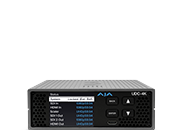
We also used UDC-4K Mini-Converters, which are my new favorites; I can’t get enough of them. On this project, they helped us convert two iMac UltraHD 4K, Rec. 709 SDR signals from HDMI to SDI for input to a large 4K router and the screen switcher for our live LED feeds. Simultaneously, we were able to use them to down-convert the UltraHD signal to HD 1080p SDR for an online live stream and recording.
The fact that we could handle both with one converter was so helpful. The UDC-4Ks have allowed us to focus more on color when moving HDMI computer signals over SDI. They’ve also given us so much flexibility because they solve so many different signal flow challenges with such accuracy. This was such a massive project, with little room for error, which is why we went with AJA tools. We know we won’t have to waste time figuring out why gear isn’t working as advertised; we just need our tools to work, and we trust AJA to do that.
Why are accurate conversions so important to event productions like these?
When you’re converting between resolutions and frame rates, there’s a lot of room for error, but if a brand’s colors don't land on the screen properly, they're going to notice and get frustrated. We often have to pause and spend time trying to fix these errors. Tools like ColorBox and UDC-4K remove that hassle.
We haven’t found another product from another manufacturer yet that delivers the same color accuracy as our AJA gear. We can easily see the screen that we’re working on and the screen the production feed is going out on, spot when the colors don’t look right, and adjust.
Where are you shifting your focus next?
Working HDR into widescreen event production is a priority for us. It’s an underserved area in our industry, largely because it’s complex. Now that we have tools like ColorBox that will help simplify HDR work, we want to bring it to more clients to improve the quality of their shows.
What advice would you offer to professionals just starting out?
Start learning now. The tools are mature, but there’s a learning curve, and understanding color matching across live event displays will help you stand out from the competition. Yes, it can be hard. Yes, it can be complicated, but if you can push through the initial challenges and not revert to what feels comfortable, you’re going to deliver a better product than most can.
Explore ColorBox, UDC-4K, and other color management and conversion solutions from AJA in more depth at https://www.aja.com/nav/products-color.
About ColorBox
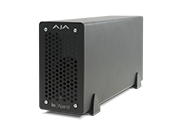
AJA ColorBox is a powerful video processing device designed to perform algorithmic and LUT-based color transformations and offers advanced-level color management with AJA Color Pipeline, as well as several color transform approaches, including Colorfront, ORION-CONVERT, BBC HLG LUTs, NBCU LUTs, and ACES. Featuring 12G-SDI in/out, HDMI 2.0 out, and ultra-low latency, OG-ColorBox is capable of up to 4K/UltraHD 60p 10-bit YCbCr 4:2:2 and 30p 12-bit RGB 4:4:4 output, perfect for live production, on-set production, and post production. OG-ColorBox’s browser-based user interface makes it simple to adjust color processing settings, whether connecting directly via Ethernet or via a third-party Wi-Fi adapter. www.aja.com/colorbox
About UDC-4K
UDC-4K is a broadcast-quality Up/Down/Cross Mini-Converter that can seamlessly convert between 4K/UHD and 2K/HD video formats. Not only does it perform raster and frame rate conversions, but it can also function as a frame synchronizer and as a 1x4 12G-SDI DA, supporting video formats up to 4Kp60. With both 12G-SDI and HDMI 2.0 inputs and outputs, the UDC-4K makes SDI and HDMI signal conversion simple and efficient. Designed on AJA’s industry-leading conversion technology, the UDC-4K offers the highest-quality required in professional broadcasting, live events, and other critical AV environments. www.aja.com/udc-4k
About AJA Video Systems
Since 1993, AJA Video Systems has been a leading manufacturer of award-winning technology for the broadcast, cinema, proAV, and post production markets. The company develops a range of powerful, flexible video interface and conversion technologies, digital video recording solutions, and color management, streaming, and remote production tools. All AJA products are designed and manufactured at our facilities in Grass Valley, California, and sold through an extensive sales channel of resellers and systems integrators around the world. For further information, please see our website at www.aja.com.
All trademarks and copyrights are the property of their respective owners.
Media Contact:
Katie Weinberg
Raz Public Relations, LLC
310-450-1482, aja@razpr.com
Products Used
-
ColorBox
-
UDC-4K